
IV Sedation Dentistry: How It Feels, Safety, and Recovery
- What Is IV Sedation in Dentistry?
- Your IV Sedation Team
- What Does IV Sedation Feel Like?
- IV Sedation vs. Nitrous Oxide and Oral Sedation
- Conscious Sedation vs. General Anesthesia
- Who Benefits From IV Sedation for Dental Anxiety?
- Finishing Years of Postponed Dental Care in Fewer Visits
- Georgia Dental Sedation Permits and Safety Standards
- Your IV Sedation Consultation
- How to Prepare for Your IV Sedation Appointment
- What Happens During Your IV Sedation Appointment
- Recovery After IV Sedation
- Recovery in Our Office
- Recovery at Home During the First 24 Hours
- Sedation Dentistry Cost and Payment Options
- Ways to Book Without a Phone Call
- Key Takeaways
- Schedule IV Sedation Dentistry at Jones & Copeland Smiles
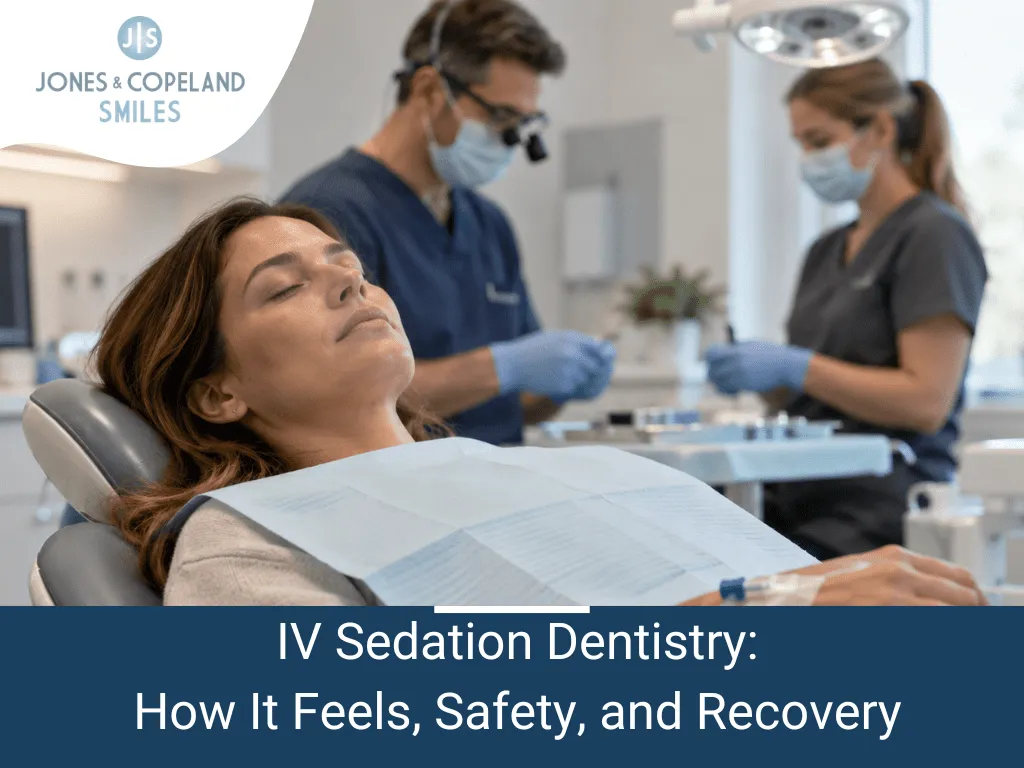
IV sedation dentistry delivers calming medication directly into your bloodstream through a small line in your arm or hand. You stay deeply relaxed while remaining able to respond to your dentist, and most patients remember little to nothing of the visit afterward. If dental anxiety has kept you out of the dental chair, IV sedation can help you get the care you need, often in just one or two appointments.
I’m Dr. Eric Jones, and at Jones & Copeland Smiles in Buford, Georgia, all four of our doctors hold a Georgia Moderate Parenteral (IV) Conscious Sedation permit. For every IV sedation visit, a CRNA or anesthesiologist joins our team to administer and manage your sedation, so your dentist can focus entirely on your treatment. With 152 years of combined experience and more than 800 five-star reviews, our team has helped many patients return to dental care after years away, always without judgment.
If you’re still comparing options, our pages on sedation dentistry basics and sedation dentistry in Buford also cover nitrous oxide and oral sedation.
What Is IV Sedation in Dentistry?
IV dental sedation, also known as intravenous or moderate conscious sedation, delivers medication directly into your bloodstream. A certified registered nurse anesthetist (CRNA) or anesthesiologist administers the medication through a thin line placed in your arm or the back of your hand, allowing it to take effect almost immediately.

According to MedlinePlus, conscious sedation combines a relaxing sedative with pain-relieving medication. Your anesthesia provider chooses the specific medications for each patient based on their health history and the treatment planned.
IV sedation is available for adults only. For children, we use nitrous oxide.
Your IV Sedation Team
At Jones & Copeland Smiles, IV sedation is a team effort. Each of our four doctors holds the Georgia permit for IV sedation, and a CRNA or anesthesiologist is with you throughout every sedated appointment. Your anesthesia provider manages your medication and watches your vital signs from start to finish, while your dentist focuses only on your dental work. With this team approach, you get two experts focused on you: one on your comfort and safety, and one on your smile.
What Does IV Sedation Feel Like?
Patients often ask what IV sedation feels like during a procedure. Most people experience a wave of drowsiness and relaxation as soon as the medication begins flowing. Some call it “twilight sleep” or “sleep dentistry,” though you remain in a semi-awake state throughout the treatment.
You may drift off for short stretches, but you can be easily awakened to respond to verbal instructions from your dentist. Your breathing slows slightly, and your blood pressure may drop a bit. Both are normal responses to the medication. Once treatment ends, most patients remember very little about the appointment, helping ease anxiety about future dental visits.
IV Sedation vs. Nitrous Oxide and Oral Sedation
Jones & Copeland Smiles offers three levels of dental sedation. Your dentist will help you select the best option based on your anxiety level, medical history, and procedure length.
| Sedation Option | How You Receive It | Level of Relaxation | Often Chosen For |
|---|---|---|---|
| Nitrous Oxide | Breathed through a small nose mask | Mild / Light | Mild nerves and shorter visits (our only sedation option for children) |
| Oral Sedation(adults only) | A pill taken at the dental office | Moderate (slower to start) | Moderate anxiety |
| IV Sedation(adults only) | A small line in the arm or hand | Moderate (fast-acting) | Severe anxiety, strong gag reflex, or complex or lengthy procedures |
Timing is one of the biggest practical differences between oral sedation and IV sedation. Oral sedation takes longer to work because your body must absorb the pill first, whereas IV sedation relaxes you almost instantly. In a 2025 clinical trial of 90 adults with dental anxiety, IV sedation took effect in about three minutes, compared to roughly 13 minutes for oral sedation.

Conscious Sedation vs. General Anesthesia
IV sedation keeps you at a moderate level of conscious sedation, meaning you continue breathing independently and can respond to your dentist.
General anesthesia leaves you fully unconscious and requires a separate permit and more monitoring equipment. In Georgia, the Board of Dentistry issues a distinct permit for deep sedation and general anesthesia. Your dentist and anesthesia provider will explain which level fits your specific treatment plan.
Who Benefits From IV Sedation for Dental Anxiety?
If fear has kept you away from dental care for years, IV sedation can help you get back in the chair. It is particularly beneficial if you experience any of the following:
- Severe dental anxiety, including trauma from past visits
- A strong gag reflex
- Difficulty sitting still in the dental chair for extended periods
- A low pain threshold
- A backlog of needed dental work
- Complex or long procedures, such as dental implant placement, full-arch implant treatment, or a full smile makeover
Your dentist and anesthesia provider will review your complete medical history and treatment plan to confirm that IV sedation is safe for you.
Finishing Years of Postponed Dental Care in Fewer Visits
Postponing dental visits often allows multiple issues to build up, like cracked teeth, worn fillings, or missing teeth. Facing a long series of separate appointments can feel overwhelming when every visit brings anxiety.
IV sedation keeps you comfortable during longer appointments, allowing your dentist to group multiple procedures into a single visit. For full-mouth work, a sedated visit can last several hours. We often combine crowns, fillings, multiple extractions with bone grafting, and multiple dental implants, and we also perform full-arch implant treatment under sedation. For some patients, we complete years’ worth of treatment in just one or two visits.
Our team has completed more than 5,800 all-ceramic crown, veneer, and implant procedures. That experience helps us combine restorative procedures, such as dental implants, into one coordinated treatment plan.
Georgia Dental Sedation Permits and Safety Standards
In Georgia, dentists must hold a permit from the Georgia Board of Dentistry to provide moderate conscious sedation. IV sedation falls under the Moderate Parenteral Conscious Sedation permit, which authorizes sedation delivered intravenously. All four doctors at Jones & Copeland Smiles hold this permit.
Georgia’s sedation permit regulations require dentists to complete:
- 60 hours of classroom instruction, including at least 20 hours in person
- Hands-on experience managing at least 20 adult patients under sedation
- Certification in Advanced Cardiovascular Life Support (ACLS)
The office is also subject to an on-site inspection to confirm it has the required sedation equipment. Asking a dental practice which sedation permits its dentists hold is a simple way to compare providers.
Who Monitors You Throughout the Procedure
Georgia law requires at least two CPR-certified team members to be present during the sedation procedure. Every team member working directly with patients must hold Basic Life Support (BLS) certification.
The office must also keep equipment that continuously tracks your blood pressure, heart rate, oxygen level, and breathing, along with emergency drugs and a defibrillator. At our office, your CRNA or anesthesiologist monitors you for the entire procedure while your dentist focuses on treatment. Your anesthesia provider follows the American Society of Anesthesiologists (ASA) monitoring standards, including:
- Pulse oximetry to track your oxygen level
- EKG to track your heart rhythm
- Capnography to track your breathing
- Blood pressure and heart rate checks at least every five minutes
Your IV Sedation Consultation
Your consultation begins with a personal conversation about your goals, concerns, and health history. Your dental team and anesthesia provider use that information to plan your sedation and dosage, so be ready to share:
- Every medication you take, including over-the-counter drugs, vitamins, herbal supplements, and prescription medications
- Any blood thinners (like aspirin or ibuprofen), as certain medications require a temporary pause
- Known allergies, medical conditions, and previous experiences with sedation or anesthesia
- Pregnancy or the possibility of pregnancy
Questions to Ask at Your Consultation
A quick list of questions can help you feel confident in your treatment plan:
- Which sedation permit does my dentist hold?
- Who will administer my sedation and monitor my breathing and vital signs during the procedure?
- How much of my treatment can we complete in a single visit?
- When should I stop eating and drinking ahead of my appointment?
- Which of my daily medications should I take on the morning of my visit?
- What will my total treatment cost, and what payment or financing options are available?
How to Prepare for Your IV Sedation Appointment
A little planning makes your appointment day easier.
The Week of Your Appointment
Reconfirm your medication list with your dentist and follow any guidelines regarding blood thinners. If you smoke, try to stop in the days leading up to your visit, since smoking slows healing. Finally, arrange for a responsible adult to drive you to and from the practice.
The Day of Your Appointment
Follow your dentist’s instructions regarding fasting. Take only approved medications with a small sip of water. Wear comfortable, loose-fitting clothing with sleeves that roll up easily, and arrive on time so you can settle in without rushing.
Checklist for Your Driver
Your driver plays an important role in your care. Make sure they plan to:
- Drive you to the office and escort you safely home afterward
- Listen to your post-treatment care instructions, as sedation makes details hard to remember
- Help you settle in comfortably at home and stay with you if recommended
What Happens During Your IV Sedation Appointment
Once you are relaxed in the chair, your anesthesia provider places a small IV line in your arm or hand. You will begin feeling calm and drowsy shortly afterward.
Your team may also give you extra oxygen through a soft tube under your nose while your dentist completes your planned dental work and your anesthesia provider watches your vital signs.
Recovery After IV Sedation
Recovery happens in two stages, starting with a short rest in our office and finishing with a quiet day at home.
Recovery in Our Office
After your procedure, you’ll rest comfortably in our office while your anesthesia provider continues to monitor your vital signs, so you’re never left on your own as the sedation wears off. Before you leave, our team will go over your aftercare instructions with you and your driver. There’s no set clock to beat: you’ll head home with your driver once your anesthesia provider confirms you’re ready, based on their standard discharge criteria.
Recovery at Home During the First 24 Hours
Plan to rest for the remainder of the day, as drowsiness can linger for several hours. For the first 24 hours post-procedure, avoid:
- Driving or operating heavy machinery
- Drinking alcoholic beverages
- Strenuous physical activity
- Making legal or major financial decisions
- Taking new unapproved medications or supplements

Most patients feel back to normal and return to their regular routine the following day.
Common Side Effects and Risks
The most common side effects of conscious sedation are lingering drowsiness, a mild headache, or minor nausea. These fade as the medication clears your system. Sharing all allergies and health history during your consultation lowers the chance of a reaction to the medication.
When to Call Our Office
If you have questions about your recovery, medications, or discomfort at home, call our office. Our team is happy to answer your questions while you recover.
Sedation Dentistry Cost and Payment Options
The cost of IV sedation varies depending on appointment length and the dental procedures completed. Because insurance coverage for sedation varies by plan, we recommend contacting your provider to verify specific benefits.
Our team provides an itemized cost breakdown during your consultation. We also offer financing that splits the cost into monthly payments.
Ways to Book Without a Phone Call
If making a phone call feels daunting, Jones & Copeland Smiles offers several easy ways to connect:
- Complete our online VirtualConsult to explore options from home
- Send a direct text message to (470) 798-0307
- Use our online scheduling tool to request a consultation
Key Takeaways
- How It Feels: IV sedation keeps you relaxed while breathing on your own and leaves you with little to no memory of the procedure.
- Your Sedation Team: A CRNA or anesthesiologist administers your sedation and monitors you throughout, while your dentist focuses on your treatment.
- Fewer Appointments: It allows complex treatments, including full-arch implants or years of postponed care, to be completed comfortably in fewer visits.
- Permits & Safety: Georgia requires dentists to hold a Moderate Parenteral Conscious Sedation permit to perform IV sedation, and all four of our doctors hold one.
- Preparation: Share your full medication history at your consultation and arrange for an adult driver on the day of your visit.
- 24-Hour Recovery: Rest for 24 hours without driving, drinking alcohol, or engaging in strenuous activity.
Schedule IV Sedation Dentistry at Jones & Copeland Smiles
Has dental anxiety kept you from getting the care you deserve? Relax, You Just Found the SMILE Experts. Our team of dentists and experienced anesthesia providers will listen to your concerns without judgment and build a plan around your comfort.
Meet our dentists online and schedule a consultation today. We proudly welcome patients from Buford, Sugar Hill, Suwanee, Flowery Branch, Hamilton Mill, and surrounding communities.
